Who Is the Best Strip Light Manufacturer in China?
Choosing the best Strip Light manufacturer in China is less about finding the lowest quote and more about verifying performance. Buyers should compare light output, color consistency, power use, thermal management, and documented quality controls. Details matter. A strip that looks bright on a sample reel may behave differently after hours inside a warm aluminum profile.
The U.S. Department of Energy’s Energy Saver guidance reports that LEDs use at least 75% less energy and last up to 25 times longer than incandescent lighting. These figures describe LEDs broadly, not every Strip Light or factory. The IEA’s Energy Efficiency 2023 report also highlights efficient end-use technologies as part of reducing energy demand. Such reports provide context, but they cannot certify an individual supplier.
A reliable comparison should examine product specifications, sample results, production consistency, warranty terms, and the clarity of test documentation. Ask how the manufacturer controls color variation between batches, and whether its stated output matches measured samples. A polished catalog can make weak evidence look convincing; I have to admit, that is easy to overlook. Factory audits and third-party test reports can add confidence, though neither guarantees every shipment will be identical. The strongest candidate is therefore not simply the largest exporter. It is the manufacturer that answers technical questions clearly, supports claims with verifiable records, and flags limitations before an order is placed.
What Defines a Strip Light Manufacturer in China?
What Defines a Strip Light Manufacturer in China?
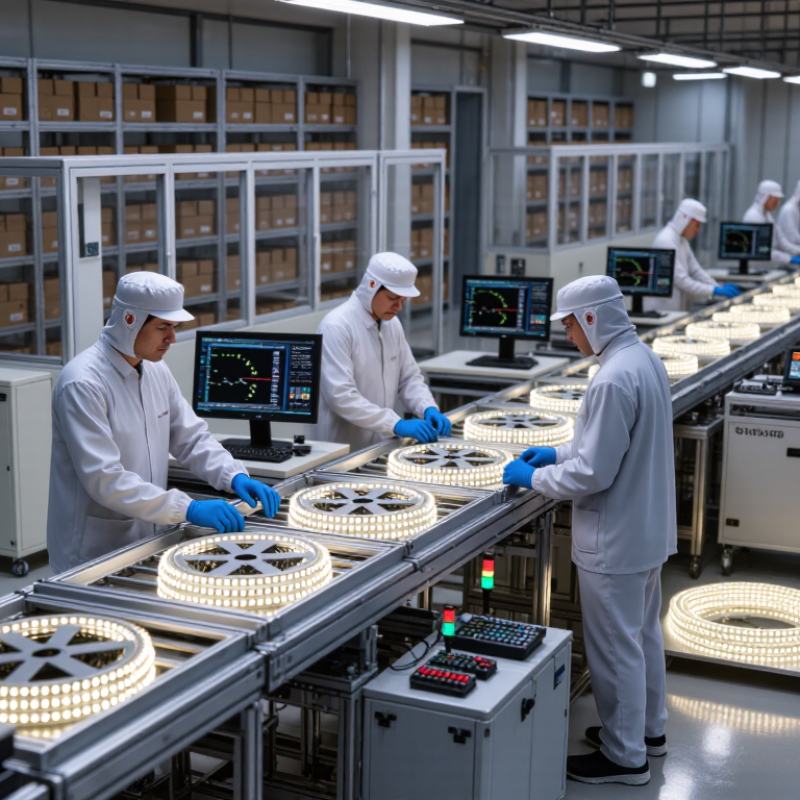
A strip light manufacturer is more than an assembly line. It should control LED selection, circuit design, soldering, encapsulation, and final testing. These steps affect brightness consistency, heat buildup, color shift, and service life. The U.S. Department of Energy’s 2020 U.S. Lighting Market Characterization found that LEDs made up about 47% of installed lighting stock. That shift raises expectations: buyers need dependable performance, not just low prices. Details count.
A credible factory can share test records for electrical safety, lumen output, color consistency, and temperature rise. Ask how it checks voltage drop along a five-meter reel, or whether samples are tested after extended operation. IEC 60598-1 and IEC 62031 provide relevant safety frameworks for luminaires and LED modules. A certificate alone is not proof that every production batch matches the sample. Batch traceability and clear quality-control procedures matter. So do honest product specifications.
Manufacturing depth also shows in practical details: copper thickness, adhesive strength, cut-point accuracy, and resistance to moisture. A supplier should explain which ratings suit indoor use and which require additional protection. Even a capable factory can miss a weak solder joint. That is why repeat testing matters. Evaluate documented results, sample quality, and communication before judging a manufacturer by catalog claims.
What Defines a Strip Light Manufacturer in China?
Common nominal DC input-voltage options for LED strip lights
Manufacturers commonly offer strips designed for 5 V, 12 V, 24 V, or 48 V DC power systems. Voltage is one specification to check alongside LED binning, thermal design, quality testing, and compliance documentation. Options vary by product; confirm the rated input voltage on the product datasheet.
Key Criteria for Evaluating Strip Light Manufacturers
Evaluating a Chinese strip-light manufacturer starts with evidence, not sample brightness. Request LM-80 reports for the LED packages and TM-21 lifetime projections. Check test duration, operating current, and temperature against your intended installation. The U.S. Department of Energy’s Energy Saver guidance reports that LEDs use at least 75% less energy and can last up to 25 times longer than incandescent lighting. These figures describe LEDs broadly, not every strip. Treat them as context, not a product promise.
Inspect the assembled strip closely. Ask for light-output and color-consistency records from several production batches, plus voltage-drop readings at the far end of a five-metre reel. Check copper thickness, adhesive strength, solder joints, and heat inside an aluminum channel. Ask how the factory manages LED binning and verifies dimming compatibility. Compare independent test reports with the exact sample model and production lot. Small mismatch, big question.
Factory controls matter beyond the showroom. Review incoming-material records, calibration logs, aging-test duration, and corrective-action reports. Ask whether the manufacturer tracks field failures and can trace finished products to production records. Not enough. A pilot order can reveal color shifts or weak adhesion that a polished sample hides. Record brightness and temperature after installation, then revisit your acceptance criteria; even careful buyers can overlook installation heat.
How Chinese Manufacturers Differ in Products and Capabilities
Chinese strip-light manufacturers differ less by location than by engineering depth, testing discipline, and production flexibility. Some focus on standard SMD rolls; others offer COB, tunable-white, high-CRI, or pixel-controlled designs. That distinction matters. The IEA’s Energy Efficiency 2023 report found that LEDs rose from 5% of global lighting sales in 2013 to 50% in 2022, while LEDs made up only 15% of installed lighting stock. Growing demand makes product consistency and reliable replacement supply important.
Capabilities show up in details. Ask how a factory controls LED binning, measures color consistency, and manages heat along a five-meter reel. Request test records for brightness, power consumption, and operating temperature—not just a glossy catalogue. For outdoor use, check the exact IP rating and how connectors are protected. For dimming, confirm compatibility with the intended controller. Small details matter.
A manufacturer with broad options may still lack strong process control. A technically focused factory may offer fewer designs but tighter tolerances and clearer test documentation. This comparison is imperfect: sample performance cannot guarantee long-term field results. Check batch records and inspect production samples where possible. A rushed audit can miss flaws. Ask what happens when a batch falls outside specification, and whether replacement parts remain available.
A Comparison of Notable Strip Light Manufacturers in China
Comparing Chinese strip light manufacturers is more useful when buyers assess production capability than when they chase a single “best” supplier. The market includes factories focused on basic indoor tape, high-density flexible boards, silicone-encapsulated products, and custom lighting assemblies. These are not interchangeable. A supplier experienced with narrow cabinet channels may not suit a long commercial run exposed to heat and dust.
Ask for a sample reel, its datasheet, and a clear account of LED binning, copper thickness, voltage drop, and adhesive type. Then inspect color consistency across the reel, solder joints at cut points, and whether the tape stays flat on aluminum. Small details matter. Request test results for lumen output and operating temperature, not just headline wattage. Check dimming compatibility with the intended driver; flicker can appear only after installation.
Manufacturers also differ in engineering support, customization lead time, and quality control between batches. A video call can clarify a process, but it cannot replace a sample and documented inspection. Compare warranty terms, packaging, and communication speed alongside unit price. Cheap quotes may come with weaker adhesive or inconsistent LEDs. That is easy to miss. It is tempting to overvalue a polished catalog. Rank suppliers only after matching specifications and verifying current production.
How to Choose the Best Manufacturer for Your Needs
Choosing a strip light manufacturer starts with the job the light must do. Will it sit in a dry cabinet, a shop display, or a humid room? Each setting calls for different protection, brightness, and color consistency. Ask for a specification sheet, then compare it with a physical sample. A neat document is useful, but it cannot reveal uneven brightness or a visible color shift. Test the sample.
Check the details that affect installation and daily use: voltage, cutting intervals, adhesive strength, connector options, and heat management. Ask how the manufacturer checks color consistency between production batches. Request clear information about warranty terms, lead times, and packaging, too. Ask for proof. A reply that avoids direct answers is worth noting, even if the quoted price looks attractive.
Quality control matters as much as the first sample. Ask whether production includes checks for lighting output, electrical performance, and appearance, and whether inspection records can be shared. If possible, start with a small trial order before committing to a larger quantity. Small details matter. Communication should stay clear when drawings change or delivery dates move. No checklist removes every risk; specifications can look complete and still leave practical questions unanswered.
