China Top Concert Lighting Manufacturers and Suppliers

China’s concert lighting market brings together manufacturers, component specialists, and export-focused suppliers. Their products can shape a show’s entire visual language, from a tight beam cutting through haze to a row of fixtures washing an arena in color. Yet a polished catalog does not tell the whole story. Buyers also need to assess optical consistency, thermal management, control compatibility, spare-parts access, and the supplier’s ability to support repeat orders.

Stage-lighting pioneer Stanley McCandless’s framework highlights visibility, naturalism, composition, and mood as essential lighting functions. These ideas remain relevant to Concert Lighting, even when modern fixtures add moving heads, pixel effects, and networked control. The technology may be new; the need for clear visual purpose is not. A dependable supplier should be able to explain how its fixtures perform in real venues, not only list brightness figures. Ask for beam samples, photometric files, and practical details about service and production testing. Small questions matter.

This guide introduces China’s top concert lighting manufacturers and suppliers, with attention to product range, manufacturing capability, customization, and communication. It is intended to help buyers compare options, not crown one universal winner. Venue size, touring schedules, budget, and technical crew experience all change what “best” means. Some specifications may look impressive on paper and still disappoint under show conditions. That is worth remembering. A careful shortlist, supported by documented tests and direct supplier discussions, is a more reliable starting point than a low price alone.
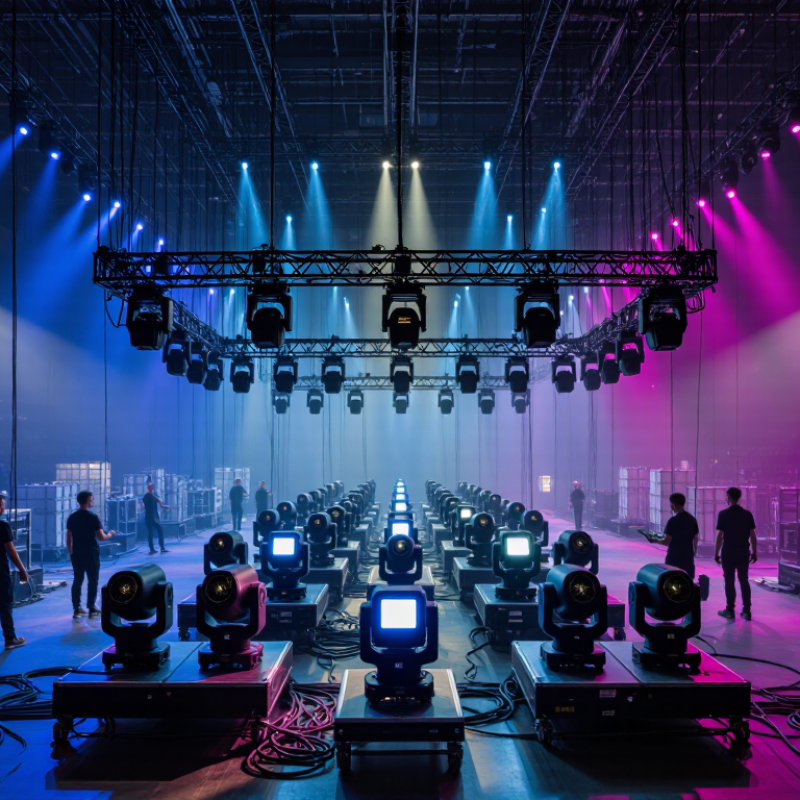
China Top Concert Lighting Manufacturers and Suppliers

Concert Lighting Industry in China: Scope and Market Overview

China’s concert-lighting industry serves arena tours, music festivals, theaters, and outdoor stages. Its scope includes moving-head fixtures, wash lights, strobes, control systems, and technical support. China’s Association of Performing Arts reported about 440,000 commercial performances and RMB 50.2 billion in box-office revenue in its 2023 performance-market report. Demand is visible. These figures describe the wider performance market, not lighting-equipment sales, so they should not be treated as a direct market-size estimate.

For buyers, the supplier landscape spans component production, fixture assembly, system integration, and rental support. A practical evaluation should check light output, color consistency, heat management, control compatibility, spare-part availability, and service response. On a busy stage, a small color mismatch can show across a wide LED backdrop. Outdoor events also require equipment suited to changing weather and repeated transport. Not every show scales. Large venues may need high-output fixtures, while smaller productions can prioritize flexible, compact units. The sector’s opportunity is clear, but public performance data alone cannot confirm supplier quality or equipment reliability; those require testing and documented technical specifications.

Core Technologies and Products Used in Concert Lighting

Concert lighting depends on coordinated systems, not just bright fixtures. Moving-head lights use motors to position beams across a stage, while LED wash units create broad fields of color. A narrow beam can cut through haze, but it may look harsh when aimed directly at the audience. Small choices matter.

Control desks send cues through DMX or network-based protocols to dimmers and fixtures. Operators build timed sequences for color changes, movement, and intensity, then test them against the music and stage layout. Pixel-mapped LED bars can display patterns across a set, though complex effects are easy to overuse. Reliable signal distribution and backup data paths help prevent frozen cues during a show.

Power planning is equally practical. Technicians check fixture loads, cable routes, rigging points, and ventilation before doors open. LED fixtures generally use less power than many older lamp systems, yet heat and airflow still need attention. A useful rig includes front light for faces, side light for depth, and carefully placed effects. The imperfect part is that no preset suits every venue; a low ceiling or reflective backdrop can change the result quickly.

Profiles of Leading Chinese Concert Lighting Manufacturers

Chinese concert lighting manufacturers vary in scale and specialization. Some focus on moving-head fixtures for touring stages, while others supply wash lights, control systems, or custom-built equipment. A useful profile looks beyond product photos. Check whether the manufacturer publishes clear specifications, photometric data, and maintenance guidance.

Production capacity matters, but so does consistency. Ask how each unit is tested, how spare parts are handled, and whether technical support can explain setup in plain language. A supplier with documented quality checks may be easier to evaluate than one offering only broad performance claims. Request a sample test or a live demonstration when practical. Paper specifications can miss real-world details, such as fan noise or color shifts at low brightness. This is not a perfect ranking method, but it helps reveal gaps.

Tips: Compare beam angle, color rendering, dimming behavior, and fixture weight against your venue and rigging plan. Ask for written warranty terms and realistic lead times. Keep questions specific. A few manufacturers may respond slowly; note that, rather than assuming their products are poor.

How to Evaluate and Select a Concert Lighting Supplier

China Top Concert Lighting Manufacturers and Suppliers

Choosing a concert lighting supplier takes more than comparing fixture prices. In practice, check beam angle, output consistency, dimming smoothness, and camera flicker performance. Ask for test videos under different refresh settings, not only polished stage footage. A narrow beam may look sharp in a showroom but disappear across a wide outdoor stage. Confirm how fixtures handle heat during long operating hours. Request product specifications, warranty terms, spare-part availability, and realistic production lead times in writing. Clear answers matter. Vague promises deserve follow-up.

Tips: Share a simple stage plot and expected show schedule before requesting a quote. Ask whether sample units or a live demonstration are available. Check connectors, control compatibility, and protection ratings against your venue conditions. Compare the full package, including shipping, setup guidance, and after-sales support. Keep the questions practical.

Communication is part of product quality. Note how quickly the supplier responds to technical questions and whether answers stay consistent across conversations. If possible, speak with a technician who understands installation and maintenance. A supplier may offer impressive specifications yet provide limited support after delivery. That can become a real problem during a tight load-in. No checklist catches everything, and I would still want a hands-on test before committing to a large order.

Manufacturing Standards, Export Services, and Industry Trends

Concert lighting manufacturers in China are judged by more than brightness and beam range. Buyers should ask how each fixture is checked, from solder joints and connectors to cooling fans and final burn-in tests. Clear quality-control records, batch traceability, and electrical safety documentation help teams compare suppliers with confidence. A sample inspection can reveal details a product sheet misses. Details matter.

Export service is part of product reliability. Confirm that manuals, packing lists, and shipping documents match the order, and ask how fragile lenses and moving heads are protected. Wooden cases or fitted foam may reduce impact damage, but packaging should suit the route and handling conditions. Response times for spare parts and technical questions also deserve attention. A fast quotation is useful; practical after-sales support matters more.

Industry trends include quieter cooling, compact fixtures, more precise pixel control, and software-based monitoring. These features can simplify rigging and programming, yet they do not guarantee a better show. Test fixtures with the intended console, cables, and power setup before committing to a large order. Manufacturers may describe performance under ideal conditions, while venues bring dust, heat, and tight changeovers. That gap is worth discussing openly.

China Top Concert Lighting Manufacturers and Suppliers - Manufacturing Standards, Export Services, and Industry Trends

Category Industry Information Buyer Checks and Practical Notes
Product scope Concert and stage lighting commonly includes moving-head luminaires, LED wash and profile fixtures, followspots, audience blinders, strobes, control consoles, and power or data accessories. Confirm the intended use, venue, mounting method, beam characteristics, control requirements, and whether the product is intended for indoor or outdoor operation.
Stage-lighting safety standard IEC 60598-2-17 covers luminaires for stage, television, film, and photographic studios, for indoor and outdoor use. IEC 60598-1 provides general requirements for luminaires. Ask for the applicable test documentation and confirm that its model, configuration, and rated conditions match the product being purchased. Standards applicability depends on product design and market.
Electrical and ingress protection IEC 60529 defines the IP Code used to classify protection provided by enclosures against access, solid objects, and water. Check the declared IP rating against the installation environment. An outdoor claim should be supported by relevant testing and installation instructions, not only a product description.
Quality management ISO 9001 specifies requirements for quality management systems. Certification, where held, applies to a defined organization and scope rather than automatically proving the performance of every product. Verify the certificate’s issuing body, validity, covered site, and scope. Also review product inspection records and the supplier’s process for handling defects and corrective actions.
Control protocols DMX512-A is a widely used digital control standard for entertainment lighting. RDM supports communication with compatible devices over a DMX-based system; Art-Net and sACN carry lighting control data over Ethernet networks. Confirm protocol compatibility, connector and pinout, addressing behavior, refresh or update requirements, and whether the fixture supports the specific features needed in the control system.
Manufacturing checks Common quality checks include visual inspection, electrical safety testing, functional testing, control-response checks, thermal evaluation, and inspection of mechanical parts and connectors. Request a documented inspection plan and acceptance criteria. For larger orders, agree on sample approval, batch inspection, packaging checks, and procedures for reporting nonconformities.
Export documentation International shipments commonly require a commercial invoice, packing list, and transport document such as a bill of lading or air waybill. A certificate of origin may be needed depending on the destination and trade arrangements. Confirm the importer’s local requirements, product classification, consignee details, shipping terms, and responsibility for duties and taxes before production or dispatch.
Market access and compliance Requirements vary by destination and product. Depending on the market, they may include electrical safety, electromagnetic compatibility, chemical restrictions, labeling, and language requirements. Identify the destination market and applicable rules early. Request relevant test reports and declarations, and verify that documentation covers the exact model and configuration.
Common export services Export-oriented suppliers may provide product customization, sample orders, export packing, shipping coordination, document preparation, and remote technical support. Confirm which services are included in the quotation, lead-time assumptions, spare-parts availability, warranty terms, and who handles transport claims or after-sales troubleshooting.
Industry trend: LED systems LED sources are widely used in modern stage fixtures. Product development often focuses on color control, optical performance, power efficiency, thermal management, and fixture weight. Compare measured or documented output under stated conditions, color performance, cooling behavior, and maintenance requirements rather than relying on wattage alone.
Industry trend: networked control Lighting systems increasingly combine conventional DMX links with Ethernet-based control networks, particularly for larger venues and productions using multiple universes of control data. Check network configuration guidance, supported protocols, device discovery and addressing options, and compatibility with the venue’s existing infrastructure.
Industry trend: modularity and serviceability Design priorities include modular components, replaceable parts, firmware maintenance, and access to technical documentation to support servicing over a product’s working life. Ask about repair procedures, replacement-part lead times, firmware update methods, and the availability of manuals, wiring diagrams, and service support.
Supplier comparison approach Useful comparison factors include product fit, documented compliance, build and test controls, communication compatibility, delivery capability, and after-sales support. Compare equivalent specifications and evidence across quotations. Product claims and service availability should be verified for each order and destination market.
Scroll to Top