Finding a top China display solution supplier requires more than comparing prices or browsing polished product pages. A reliable partner must understand your application, viewing distance, brightness needs, installation conditions, and maintenance expectations. The right supplier should turn these details into a practical display solution, not simply recommend its newest model.
As display-industry analyst Ross Young has observed, “The display industry is a very cyclical industry.” That reality makes supplier stability important. A capable manufacturer should provide clear technical specifications, production evidence, quality-control records, and realistic delivery estimates. Ask for sample units, not only digital brochures. Inspect brightness uniformity, color consistency, viewing angles, heat management, and cabinet construction under real conditions. A showroom screen can look excellent. Your finished installation may not.
Experience also appears in small details. Can the supplier explain pixel-pitch selection without confusing your team? Can it identify likely failure points before production? Does it offer traceable testing and responsive after-sales support? Request references from projects similar to yours, preferably with comparable climate, operating hours, and screen size. Independent certification and documented warranty terms add useful confidence, although paperwork alone cannot prove performance.
Some buyers focus too heavily on factory size. That can be a mistake. A smaller specialist may provide stronger engineering support, while a large supplier may offer broader manufacturing capacity. Neither assumption is always correct. Evaluate evidence, communication, and accountability together. Visit the facility if possible. Speak with the technical team, not only the sales representative. A top China display solution supplier should make risks visible before your purchase, even when that honesty slows the conversation.

How to Find a Top China Display Solution Supplier?
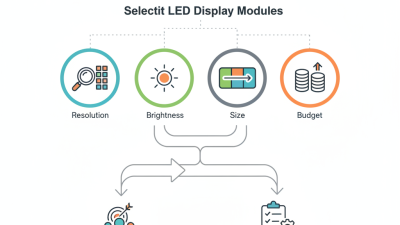
Define Display Requirements Using Brightness, Resolution, and Viewing-Distance Data
A reliable display project starts with measurable conditions, not a supplier’s generic product list. Record ambient light at the installation point, preferably in lux, during the brightest operating period. VESA’s DisplayHDR specifications use peak brightness tiers such as 400, 600, 1,000, and 1,400 cd/m². These values offer a useful reference, but peak brightness is not sustained brightness. Ask suppliers for measured brightness, uniformity, viewing angle, and operating temperature data.
Viewing distance directly affects pixel pitch and resolution. For fine text viewed from two meters, a small-pitch LED display may be necessary. A common planning rule estimates minimum viewing distance in meters as roughly equal to pixel pitch in millimeters. It is only an estimate. Content, eyesight, camera use, and text size can change the result. For example, a 2.5 mm pitch may suit medium-distance signage, but detailed control-room graphics may need a tighter pitch. The AVIXA 2024 Industry Outlook and Trends Analysis highlights digital signage as a mature professional AV application, where performance depends on application conditions, not specifications alone. Request a sample panel, brightness test report, pixel-failure policy, and calibration records. My own caution is simple: a neat formula can still mislead. Evaluate the actual content at the actual distance.
This planning chart connects typical viewing distances with practical display requirements. Brightness increases for outdoor or high-ambient-light environments, while higher pixel counts are preferred when viewers are closer or when fine details must remain sharp. Final specifications should also consider screen size, content type, ambient light, and installation conditions.
A strong display supplier should prove factory capability, not only show attractive samples. ISO 9001 certification offers a useful starting point. The ISO Survey 2022 recorded 1,265,216 ISO 9001 certificates worldwide, showing its broad industrial adoption. However, certification alone is not proof of consistent production. Confirm the certificate number, issuing body, covered site, scope, and expiration date. The scope should include design, manufacturing, assembly, or related display activities.
Ask for recent audit records. Check surveillance dates, major findings, minor findings, and corrective-action evidence. A reliable factory can explain how it controlled a repeated issue, such as uneven acrylic edges, unstable lighting, or incorrect color matching. Look for measurable evidence. Examples include inspection reports, calibration records, incoming-material checks, and final sampling results. The ISO 9001 standard emphasizes documented processes and continual improvement, but paperwork can still be weak.
Do not accept vague files. Request redacted records when confidentiality applies. Compare the audited address with the actual production site. The International Accreditation Forum’s audit-duration guidance also shows that audit depth depends on organization size and complexity. A small certificate may not represent every workshop or subcontractor. This is where buyers often overlook risk. A factory may pass an audit yet struggle during a large seasonal order. Verify capacity through recent production schedules, equipment lists, staffing levels, and delivery records. Some evidence may be imperfect. That is normal. What matters is whether the supplier responds clearly, corrects gaps, and permits reasonable verification.
A reliable display supplier should explain total cost, not only the purchase price. LED modules rated for up to 100,000 operating hours can reduce replacement frequency. However, that figure is a laboratory reference, not a promise for every installation. Ask how brightness, heat, humidity, and daily operating time affect the rating. Request test reports, maintenance records, and clear warranty terms.
Calculate the cost over the display’s expected service period. Include equipment, shipping, installation, electricity, spare modules, labor, and planned downtime. A cheaper cabinet may consume more power at a busy transport hall or retail entrance.
For example, a display running 14 hours daily needs roughly 5,110 operating hours yearly. At that rate, 100,000 hours represents many years, but power supplies and control cards may fail earlier.
During supplier evaluation, inspect pixel consistency, front or rear maintenance access, thermal design, and service response times. Ask for a sample unit or a controlled factory demonstration. Compare measured power consumption instead of trusting a brochure alone. I have seen buyers focus heavily on LED lifespan and overlook replacement labor. That is an expensive blind spot. A stronger supplier will disclose limitations, provide realistic calculations, and adjust recommendations to the installation environment. Even careful estimates can be imperfect. Recheck them with actual operating data after deployment.
Finding a top China display solution supplier requires evidence, not attractive samples. Test color accuracy with a calibrated spectroradiometer under D65 lighting. Record Delta E, white balance, gamma, and viewing-angle performance. A supplier should provide factory calibration data and repeatability results from multiple units. One perfect sample proves little. Production variation can still appear.
Reliability testing should include burn-in, thermal cycling, humidity exposure, vibration, and ESD testing. Request test conditions, failure limits, and corrective-action records. IEC 62368-1 may apply to product safety, while IEC 61000-4-2 covers electrostatic discharge testing. The 2024 Global E-waste Monitor reports 62 million tonnes of electronic waste in 2022. Only 22.3% was formally collected and recycled. This makes RoHS material control and responsible product design more than paperwork.
Tips: Ask for the CE Declaration of Conformity, not only a CE logo. Check the technical file, risk assessment, and applicable IEC reports. Confirm RoHS evidence through supplier declarations and laboratory screening, such as XRF testing. Verify factory calibration with your own reference unit. Small mistakes matter. I would also audit one production batch before signing a long-term agreement. Compliance documents can be complete, yet supplier controls may remain weak.
| Evaluation Area | Key Measurement | Recommended Test Method | Practical Acceptance Benchmark | Required Evidence | Suggested Weight |
|---|---|---|---|---|---|
| Color Accuracy | Average color difference, ΔE00 | Measure calibrated samples with a spectroradiometer or colorimeter under a defined white point and luminance setting; calculate CIEDE2000 values. | Average ΔE00 ≤ 2.0 for professional imaging; ≤ 3.0 for general industrial or commercial displays. | Instrument model, calibration record, test environment, measurement files, and sample-to-sample results. | 20% |
| White Point and Gamma | Color temperature, luminance, and gamma consistency | Test at the specified operating mode after a minimum warm-up period; compare multiple units and brightness levels. | White point typically within ±300 K of the agreed target; gamma deviation within ±0.10; luminance uniformity ≥ 85%. | Factory calibration procedure, uniformity map, gamma curve, and final inspection report. | 10% |
| Reliability Testing | Temperature, humidity, vibration, and power-cycle performance | Use an agreed qualification plan based on IEC 60068 environmental test methods and the product’s intended operating conditions. | No functional failure, safety issue, permanent image defect, or unacceptable brightness/color drift after qualification testing. | Reliability test plan, chamber records, vibration profile, power-cycle count, failure analysis, and corrective-action reports. | 20% |
| Display Lifetime | Expected operating life and brightness retention | Review accelerated-life data and the manufacturer’s defined lifetime condition, including temperature, duty cycle, brightness, and acceptable lumen or luminance loss. | For many commercial LCD applications, an L70 claim of 30,000–50,000 hours may be appropriate when supported by test data; requirements vary by technology and use case. | Lifetime definition, extrapolation model, test duration, operating conditions, and warranty terms. | 10% |
| CE Compliance | Conformity with applicable European Union requirements | Confirm the applicable directives and regulations according to the final product configuration, intended use, power supply, radio functions, and installation environment. | Complete technical documentation and a valid EU Declaration of Conformity for the finished product; CE marking must be applied correctly. | EU Declaration of Conformity, technical file index, risk assessment, applicable test reports, labeling artwork, and user instructions. | 15% |
| RoHS Compliance | Restricted substances in homogeneous materials | Verify material declarations and, where required, use laboratory screening or chemical analysis for restricted substances under Directive 2011/65/EU and its amendments, including Delegated Directive (EU) 2015/863. | Material concentrations must remain within the applicable maximum limits, such as 0.1% by weight for most restricted substances and 0.01% for cadmium in homogeneous material. | Supplier material declarations, BOM traceability, laboratory reports, exemption references, and change-control records. | 10% |
| IEC and Electrical Safety | Safety, EMC, and applicable display-device requirements | Identify the correct IEC or EN standards for the product architecture; commonly relevant standards may include IEC 62368-1 for AV/ICT equipment and IEC 61000-series EMC requirements. | Pass applicable electrical safety, insulation, abnormal-operation, emissions, and immunity tests with no unresolved critical deviations. | Accredited laboratory reports, standard editions used, test configuration, deviations, and corrective-action evidence. | 10% |
| Quality Management | Process control, inspection, and nonconformance management | Audit incoming inspection, production control, calibration, traceability, final inspection, and corrective-action processes. | Documented quality system, calibrated equipment, traceable production lots, controlled work instructions, and measurable corrective-action closure. | Quality manual, process flow, inspection standards, calibration certificates, audit results, and sample inspection records. | 10% |
| Sampling and Final Approval | Consistency across production samples | Evaluate pre-production and pilot samples using an agreed inspection plan, such as ISO 2859-1-based lot sampling, with critical defects treated separately. | Zero unresolved critical defects; major and minor defect limits defined in advance; color and brightness remain within approved golden-sample tolerances. | Approved golden sample, inspection-level definition, AQL agreement, defect photographs, and signed final-approval record. | 5% |
| Total Suggested Evaluation Weight | 100% | ||||
Delivery claims mean little without records. Ask for 12 months of purchase-order data, not selected examples. Compare promised dates with actual arrival dates, using on-time-in-full delivery and lead-time variance.
The World Bank’s 2023 Logistics Performance Index gives China a 3.8 score for timeliness, showing strong capability but not guaranteed factory performance.
Request shipment records by product model, destination, and season. A supplier that reports 96% on-time delivery should also explain the remaining 4%. Delays happen.
Warranty terms reveal operational maturity. Check the coverage period, excluded failures, pixel policies, replacement procedures, and freight responsibility.
Then request anonymized warranty data, including claim rate, mean repair time, repeat-failure rate, and spare-parts availability.
Warranty Week’s 2024 market analysis highlights how service costs and contract obligations can materially affect lifecycle value.
Do not accept “lifetime support” without a written service-level agreement. For support, measure first-response time, resolution time, escalation ownership, and remote-diagnostic capability.
Salesforce’s State of the Connected Customer report found that 88% of customers consider experience as important as products, although that figure is not display-specific.
A practical pilot can expose weaknesses: test one urgent replacement, one firmware issue, and one damaged shipment. Keep the results. Gut feeling is useful, but incomplete.