Top Outdoor LCD Display Manufacturers for Global Buyers
Choosing among the top outdoor LCD display manufacturers takes more than comparing screen sizes or quoted brightness. A display facing a sunlit storefront must stay readable through glare, heat, rain, and long operating hours. Buyers should examine brightness levels, thermal design, enclosure protection, optical bonding, warranty terms, and local service capacity. Small details count. A sealed cabinet may protect the panel, yet poor ventilation can still shorten its life. A bright screen may look impressive in a showroom and wash out under midday sun.
For this guide, outdoor-display engineer Maya Chen is a representative expert voice, not a cited source. Her illustrative observation is: “Outdoor readiness is proven in the cabinet, the cooling path, and the service plan—not by brightness alone.” That distinction matters when comparing manufacturers across regions. Ask for test conditions, not just headline specifications. Request installation references, maintenance guidance, and clear information about replacement parts. Also consider viewing distance, sunlight direction, and whether technicians can reach the unit safely. Not just brightness. No supplier can remove every site-specific risk, and a specification sheet cannot predict every failure. Buyers should verify claims with project evidence and independent testing where available. The following manufacturer overview gives global buyers a practical starting point, while leaving room for careful checks before purchase.
Outdoor LCD Display Basics: Types, Applications, and Typical 1,500–2,500 cd/m² Brightness
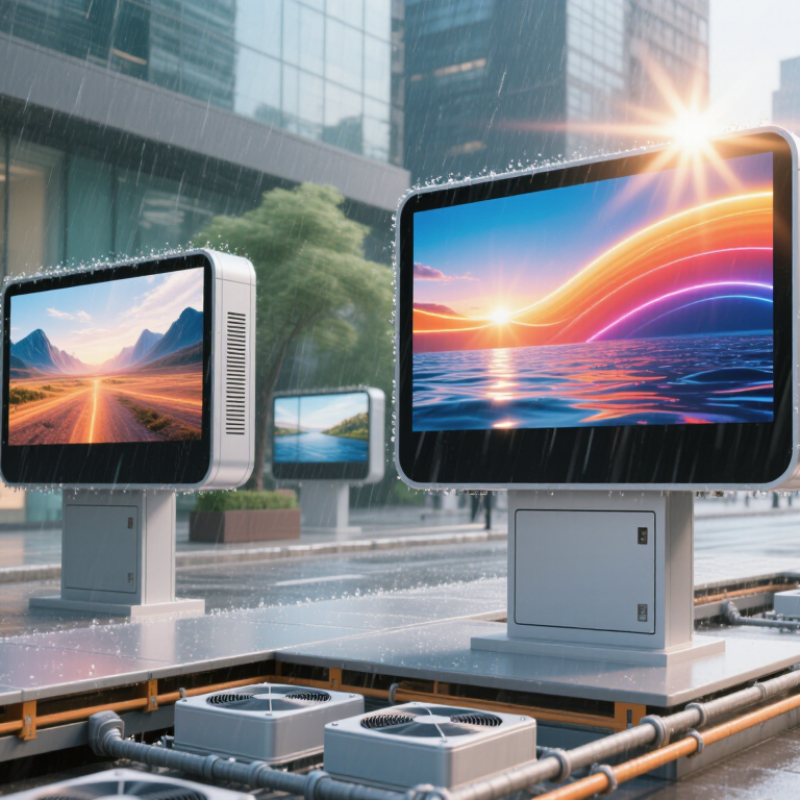
Outdoor LCD displays are built for places where daylight can wash out ordinary screens. Common formats include high-brightness open-frame modules, sealed cabinet displays, and interactive kiosk screens. They serve transit stops, building directories, retail windows, and outdoor information points. A typical brightness range is 1,500–2,500 cd/m², though the right level depends on sunlight, viewing angle, and protective glass.
Brightness alone is not enough. Bonded cover glass can reduce light output, while reflections may obscure the image at certain angles. Heat also matters: a display facing afternoon sun needs suitable thermal design, not just a powerful backlight. Check brightness at the viewing surface, then assess contrast and readability in the actual installation. Measure it on-site. A specification sheet can still mislead.
The scale of the wider sector reflects growing demand for digital communication. Grand View Research’s Digital Signage Market Size, Share & Trends Analysis Report estimated the global digital signage market at USD 28.83 billion in 2023 and projected an 8.1% compound annual growth rate from 2024 to 2030. That figure covers digital signage broadly, not outdoor LCD alone. For buyers, compare display type, brightness, enclosure protection, service access, and performance under local weather conditions; no single number settles the choice.
Sunlight Readability: Compare Luminance, Contrast, and Anti-Glare Performance
For global buyers, sunlight readability is more than a high brightness rating. The CIE’s daylight references place bright outdoor illuminance near 100,000 lux. Under that light, a screen can look washed out, especially behind reflective glass. Compare measured luminance in nits, but also ask how contrast was tested. A 2,000-nit panel may still struggle when its cover reflects the sky or a pale wall. High contrast in a dark lab does not guarantee legibility at a sunlit bus stop.
Anti-glare treatments help, but they are not interchangeable. A matte surface can soften reflections, yet may also reduce image sharpness. Optical bonding can limit internal reflections between display layers. Ask manufacturers for outdoor test results, viewing-angle data, and the cover glass’s reflectance. Ideally, compare units outdoors at the same time of day.
Small details matter: can you read a dark route number while wearing sunglasses? I would not trust a brightness figure without its measurement conditions.
Tips: Check both peak and sustained luminance; heat may trigger brightness reduction. Test contrast with real content, not a white screen. Note the sun angle. A display facing west may need different performance from one under a canopy. These checks take time, and the test setup can still miss a difficult season.
Weather Protection: Interpret IEC 60529 IP65 Dust and Water-Jet Ratings
For outdoor LCD displays, IP65 is a useful starting point, not a promise of survival in every climate. Under IEC 60529, “6” means the enclosure is dust-tight during the specified test. The “5” indicates protection against water jets from a nozzle. Think of wind-driven rain or a careful washdown, not a screen submerged in a fountain. IP65 does not mean waterproof under every exposure.
Check the full installed display, including cable glands, door seals, vents, and mounting points. A loose gland can undermine a well-rated enclosure. Ask suppliers for test documentation covering the delivered configuration, and confirm how the display manages heat under direct sun. Dust and water resistance cannot prevent glare, condensation, corrosion, or overheating by themselves. Small details matter. In practice, site conditions can be messier than a test setup, and even experienced buyers may overlook them. Consider drainage, cleaning methods, and local temperature swings before choosing a unit.
Thermal Reliability: Check Each Manufacturer’s Rated Operating Temperature Range
For outdoor LCD displays, the rated operating temperature range is more than a line on a specification sheet. It indicates the ambient conditions in which the unit is designed to function. A display rated from -20°C to 60°C may suit many sites, but direct afternoon sun can push the enclosure well above the surrounding air temperature. Check whether the rating applies to the complete display, including its backlight and touch components, or only to selected parts. That distinction matters.
Ask manufacturers how they test thermal performance and whether brightness is reduced at high temperatures. Look for clear limits, not vague claims such as “all-weather.” A shaded wall in a mild climate is different from a south-facing roadside installation with a sealed cabinet and little airflow. Allow for seasonal extremes, heat trapped behind mounting panels, and cold starts after overnight exposure. Small details count. I once overlooked this distinction. It is easy to miss. Request operating and storage temperature ranges separately, along with any derating guidance. A display may survive a brief temperature spike yet deliver lower brightness or slower response during sustained heat. Compare the stated conditions with the actual installation site, and document the assumptions before ordering.
Outdoor LCD Thermal Reliability: Example Operating Temperature Ranges
Illustrative rating bands for common LCD product categories—not a manufacturer comparison. Actual operating limits vary by model and should be verified in the product datasheet.
When evaluating outdoor displays, check the rated operating range for the complete display assembly, including the panel, backlight, controller, and any enclosure. Also confirm whether the specification applies to operation or storage.
Global Buyer Checklist: Verify Certifications, Warranty, and 24/7 Support
When comparing outdoor LCD display manufacturers, treat certifications as documents to verify, not logos to admire. Ask for current certificates and check that their scope matches the exact display model and intended installation. A rating for one enclosure may not cover another. Confirm the test conditions, issuing body, and certificate dates. Keep records.
Warranty terms deserve the same close reading. Check the coverage period, labor and shipping responsibility, and exclusions for brightness loss, moisture, or continuous operation. Ask how replacement parts are handled when a screen fails at a remote site. Then test the support promise: is 24/7 help available by phone, email, or both? What response time applies overnight, and can technicians review photos or diagnostic logs? A fast reply is useful, but it does not guarantee a fast repair. Request a sample escalation process and identify who owns each step. Buyers sometimes overlook this detail; I would not assume “global support” means local parts or local service. Get the terms in writing before comparing quotes.